
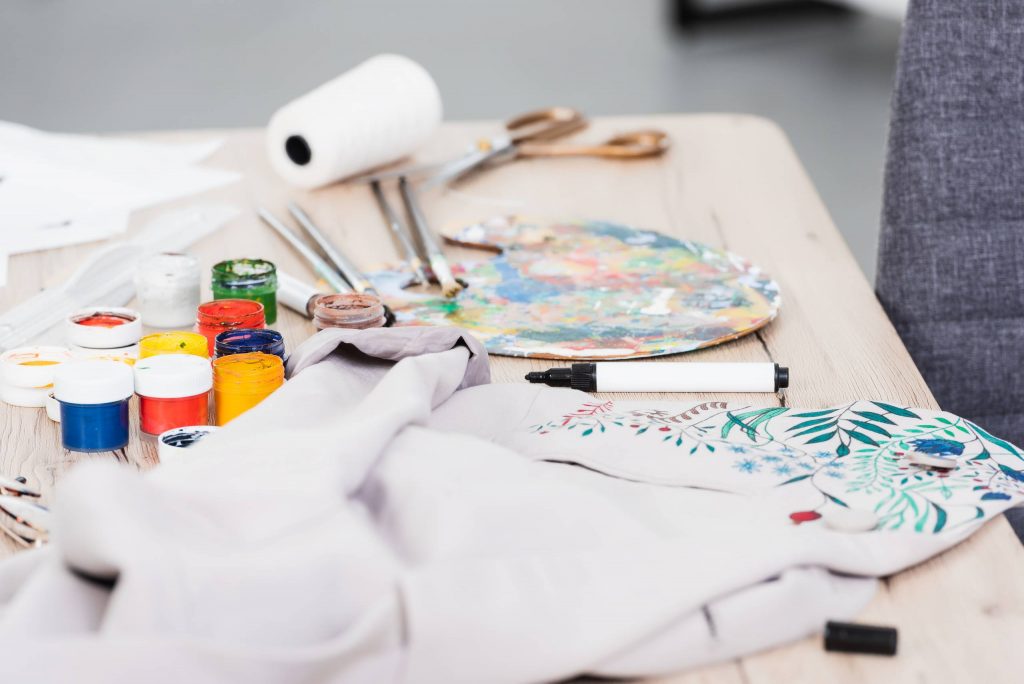
One of the oldest forms of printing, block printing lends itself to wonderful, rich, all-over patterns and the hand of the maker is evident in the printed surface. Carving your own printing blocks (typically made of mango wood in India or linoleum in modern versions) is an art in itself, and although there are many beautiful blocks available for purchase, a true handmade printed fabric will typically begin with a design that’s been hand-carved into a block. The design is drawn on the block, then chiseled and gouged out with hand tools, leaving the printing areas raised. A thick, pigmented paste (essentially, a type of paint) is rolled or daubed onto the block, then stamped onto a pre-washed and stretched fabric with great force, leaving a slight indentation where the block meets the cloth. The block is repeated across the surface in a specific manner to create an all-over, border, or medallion-style print. Irregularities of application and pressure can create lovely, organic imperfections in the print. Hand block printing is a very hands-on process and feels quite meditative.
Now, though, it’s common to see much more modern designs used for block printing, and artists are having fun with all sorts of things from larger scale prints to combining lots of colors (especially gorgeous layered ones!) and even combining it with other techniques. The best part is, it’s just as possible for beginners to do! In the beginning, it’s often easiest to start with smaller blocks that are simple shapes to get used to applying even pressure and making sure your blocks are lined up properly. As you get a bit more confident in your skills, you can move onto using multiple blocks to create more detailed images that involve some planning to make sure everything lines up properly for each color. Typically, you would do an outline first, then any fill-in colors, and then small details last. You can use any fabric you like, but most of the time cotton and linen work really well for nice, sharp lines, while silk gives a beautiful, softer effect and canvas gives a beautiful textured look if you use a super thick ink! Using transparent ink over an opaque color is also gorgeous for adding some dimension and playing with color, and part of the fun of using hand-carved stamps is embracing the little “mistakes” that happen when the colors don’t quite overlap or the ink doesn’t fully saturate the fabric.
I love that block printing can be used for utilitarian objects as well as art pieces — that the same design can be printed on a tablecloth or napkin, pillow or dress, wall hanging or yardage for curtains or quilts. The way that the designs on a printed scarf flow when you wear it, how a beautiful print on yardage can add some personality to a room when turned into curtains or a quilt. The way that block printing can be combined with other techniques like embroidery (printing with an outline to be embroidered in) or discharge (printing with the same shade, but lighter, for some wonderful subtle color variations). Plus, I love that block printing is so eco-friendly — that it uses water based inks and that it can be printed on natural fibers, and that a block can be printed and reprinted and reprinted, so that a design can change and morph without the need for a lot of waste. I love the fact that we are able to share our knowledge of how to keep blocks healthy, the need for thicker inks in hotter climates, and how to print a repeat consistently. The fact that it’s not a solo endeavor — that we can all work together.
One of the most beautiful things about block printing, and where it seems most empowering for self-improvement, is that while it requires initial structure in the form of a carved block, it leaves plenty of room for self-expression through the physical application of pressure, or less of it, to enhance the vibrancy of the colors of your prints. With more practice, you can feel the hand becoming more assured, the eye improving in detecting even the slightest misregistration, the sense of beauty refining as you revise designs. And, of course, each fabric print reflects the time spent carving the blocks, testing the designs on pieces of scrap fabric, and finally getting that satisfying third color to line up just so. What a gift to know your work, your patience and your talents, resulted in a truly handmade fabric!
Either way, block printing is a meditation in repeat, a mastery of both motif and substrate, a commitment to a slow process that tolerates no instant gratification. And, it’s a practice in which the slight imperfections of the handmade are anticipated and even welcome. For artists working in either traditional or modern aesthetics, there’s a meditative process involved in creating fabric with hand-carved blocks, and the resulting patterns and repeats are sure to be treasured.